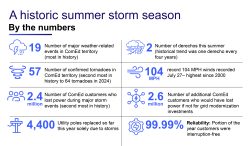
Northern Illinois has battled the most intense stretch of severe weather ever recorded in ComEd’s 119-year history. Nineteen major storms systems hit the region in 2026, unleashing 57 tornadoes and two derechos, a type of widespread windstorm typically seen here only once every three to four years. Those events caused more than 2.4 million combined customer interruptions.
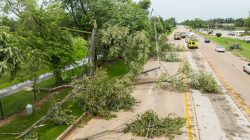
August 2026 storm destruction.
A storm year of this magnitude could easily have produced the worst reliability year on record. It did not. In fact, there have been years with less severe weather but more customer outages.
This is a consequence of investments ComEd started making in 2012, upgrading and hardening the grid to reduce the impact of extreme weather events. If not for these investments, the number of customers without power in this year’s storms would have been more than double what it was.
This focus on continuously applying new technologies to the grid and to operating practices speeds up restoration times as well. Advanced monitoring equipment, which is installed across the system, detects problems, isolates damage and reroutes power automatically. Drones give ComEd a bird’s eye view of storm damage that would be hard to detect at ground level. Trucks and mobile command trailers equipped with onboard computer systems keep crews connected to maps, work assignments and real-time updates.
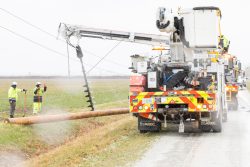
ComEd crews replace a utility pole in the aftermath of a tornado.
During his 35-year career at ComEd, underground lead crew leader Michael Daddio has been at the center of this evolution.
“What really stood out is the amount of storms we’ve had and how quickly we were able to pick everyone up,” he said. “All the work to advance the grid is worth its weight in gold this year. Not only would there have been more outages, the duration of outages would have been longer too.”
Responding to storms and restoring power this year was not a simple matter of reenergizing lines. Workers had to rebuild significant parts of the system. Crews performed this work in 16-hour shifts, replacing 4,400 utility poles, 1,700 transformers and 2.6 million feet of wire and cable.
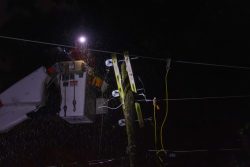
Crews performing work at night.
“We’re used to long hours, working for utility that’s what you sign up for, we train for this and we stay prepared,” Daddio said. “It’s easier to work a lot of hours in the storm when you know you’re helping people. That’s the pride in it, seeing people really appreciate us when we turn their lights back on.”
Coordination extended beyond ComEd, with teams working alongside community leaders and emergency management partners throughout each storm to effectively make repairs and keep local officials informed.
Even amid a storm season for the record books, ComEd has still achieved a 98 percent reliability rate across the duration of the year. The grid must continue to advance in order to keep pace with the more frequent and more intense severe weather that northern Illinois is experiencing.
ComEd’s latest grid plan accounts for these evolving conditions with proposed investments designed to further strengthen resilience and maintain reliability as storms intensify and demand for power continues to grow. This year exemplified the importance of that focus: the system held strong, and so did the people who operate it.