
With power demand rising due to electrification, data centers, and other emerging needs, investing in transmission infrastructure—including an expanded network of substations—is critical to strengthening power lines, enhancing resilience, and maintaining ComEd’s nation-leading reliability. To support this growth, ComEd has launched a new resource to train the engineers who maintain the transmission system that moves power safely and efficiently.
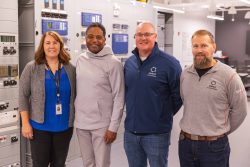
Calvin Butler, Exelon President and CEO, visits ComEd’s TCE Lab
Formally opened last month, the Testing and Commissioning Engineering (TCE) Lab is a state-of-the-art training hub designed to provide hands-on instruction for employees working in substations. This facility ensures workforce readiness and safety as ComEd expands its substation network to meet the region’s evolving energy needs.
“Our work in substations doesn’t allow for mistakes. The smallest error could impact the transmission and distribution grid and disrupt power for customers,” said Bill Theriault, manager of testing and commissioning engineering at ComEd, and a lead designer of the TCE Lab. “In the past, it could take up to five years for an engineer to gain enough experience to work independently. The TCE Lab changes that by creating a simulated control room where employees can develop skills without impacting live systems.”
TCE engineers regularly work on systems in the field alongside construction crews, testing or commissioning upgrades to equipment like protective relays, control circuits, and communication systems to safeguard the grid and ensure reliable power delivery.
TCE is a high-precision field, and a single error can impact power flow and interrupt service to customers. With its simulated substation control room, the TCE Lab addresses this challenge by allowing engineers to train without risk to the live grid, and work on real equipment with lower electric currents, heightening safety for early-stage training.
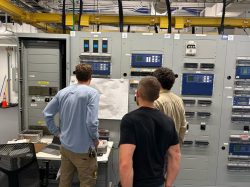
A substation control room is the brain of a substation where engineers monitor and control the equipment that moves electricity through the grid. Designed with real substation control room equipment including microprocessor and electromechanical relays, Supervisory Control and Data Acquisition (SCADA) devices, communication protection devices, fiber ring network devices, and control panels, the lab enables engineers to practice scenarios that mirror actual field conditions, including error situations, without requiring an outage on the system.
Developed over the last three years, the 3,000 square foot facility was a collaborative effort across ComEd engineering teams to design and direct the lab’s construction.
“The TCE Lab is designed to be a fully functional and interconnected system and is the most realistic representation of a substation control room compared to any lab we have seen, giving us the ability to introduce real-world scenarios, including common problems, in a safe environment,” said Bill. “That means hands-on learning without the risk of outages, and it’s a game-changer for building confidence and readiness.”
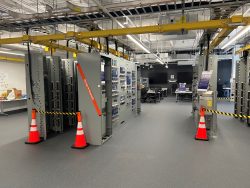
During training at TCE lab, employees can work through complex commissioning and troubleshooting tasks, learning how to respond effectively before encountering these challenges in the field. By compressing the timeline for workforce readiness, the lab allows engineers to become proficient in about a year, depending on project needs, rather than several years.
Additional benefits of the TCE Lab include supporting ComEd’s workforce development programs, including Power Up Academy. The lab’s relay demonstrations brought instruction lessons to life, helping participants understand schematics by working on the simulated equipment and setting them up well for a real substation tour.
The TCE Lab is designed for long-term impact and will prove invaluable to preparing ComEd engineering teams for work in the field. Future plans include expanding its capabilities to offer self-guided exercises and flexible access for employees, allowing continuous learning and skill reinforcement without requiring instructor-led sessions, and ensuring a safe environment. Beyond internal benefits, the lab offers opportunities as a platform for community engagement and STEM education, providing insight into substation operations and showcasing career opportunities in energy.
For information about ComEd’s other workforce development programs, visit ComEd.com/Training.
