Drone Imagery and AI Technology Speed Up Process for Maintaining Utility Poles, Reduce Potential Power Outages for Customers
April 7, 2026

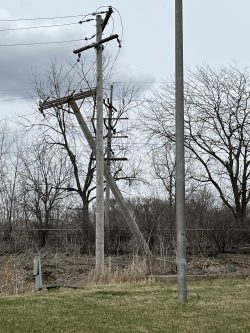
Distribution poles damaged from storm
To deliver power across northern Illinois, ComEd relies on a network of more than 1.3 million power distribution poles. Maintaining these poles is costly and time-consuming, but an emerging technology may be a game changer.
Traditionally, wooden pole inspections are conducted manually from the ground. Field crews measure the circumference of the base of the pole, then perform engineering calculations to determine how much remaining strength the pole has.
Drone technology and AI offer a more innovative solution. ComEd’s grid analytics team has recently conceived of a new system to supplement this inspection procedure. It has the potential to speed up maintenance processes, as well as reduce potential power outages for customers.
One valuable indicator of the health of a wooden utility pole is the amount of decay around the center of the very top of the pole, which is only visible from a bird’s eye view. Drones help efficiently gather images like those below. ComEd engineers and data scientists coded an AI model that analyzes the images to determine the pole’s overall strength. This not only detects pole tops that are damaged or decayed, it assigns a “health score” to rank the poles, helping ComEd teams decide which are most urgently in need of being replaced or reinforced.
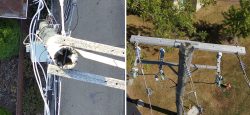
Decaying pole top (left) compared to healthy pole top (right)
“More utility companies are using image detection models to identify damaged equipment,” said Joey Martinez, principal data scientist for ComEd’s grid analytics team. “Our pole top AI health ranking model goes a step further by giving us a more actionable list of poles to prioritize for restoration, which improves budgeting and scheduling efficiency.
“Identifying these poles is huge for reliability,” he continued. “By being proactive, we can replace poles that pose a risk of falling or breaking during a storm and prevent outages for our customers.”
Field crews began capturing drone imagery of the pole tops in 2024, and the grid analytics team completed the computer vision models in early 2025. To train the AI models, the team input data of thousands of expert image comparisons provided by field engineers, based on the question, “which pole is worse?” This creates a scalable AI that thinks like the best pole inspectors, and the model has already reached 86 percent accuracy compared to human expert agreement.
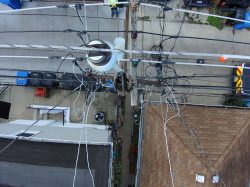
Maintenance Inspector captures photo of pole top with drone
“We believe that we are the only utility in the industry currently utilizing this new approach, and we are excited to share it,” said Tom Mahar, principal data scientist for ComEd’s grid analytics team.
Forensic research introduced to this initiative has the potential to further improve pole maintenance processes. Six retired poles, identified by the pole top AI health model, were sent to the ComEd forensics lab to be sectioned and analyzed to identify the area of the pole that has the most decay. For aging poles with less damage, a C-Truss reinforcement can be installed to increase lifespan. This forensics research aims to better inform how and when these reinforcements can be used to maximize their effectiveness.
“At ComEd, we’re always looking for better ways to run our operations—more efficiently, more effectively, and with our customers in mind,” said Jim Ortega, director of grid analytics for ComEd. “That means bringing new technologies into how we manage and maintain the grid, including automation and predictive analytics. This pole-top AI health project shows what’s possible through collaboration across our employees and teams, using smart tools to spot issues earlier and keep power flowing reliably for the people who count on us every day.”
The project will be further enhanced as additional pole top imagery is collected and incorporated with forensics insights. This will help strengthen the AI models and improve prioritization of pole replacements, reducing potential outages for ComEd customers.
Read more utility innovation stories on the Powering Lives Network
This story is part of a series highlighting ways that ComEd is acting on its Long-Range Strategy priorities of investing in People, Power and Progress.
