
By Emilia Fischer
Illinois is striving for a future power grid with zero emissions – but where to start?
In ComEd’s northern Illinois service territory, electricity flows across some 74,000 miles of transmission and distribution lines. It passes through thousands of substations and terminals, plus millions of smart meters, among countless other grid components.
Within this vast network, high-voltage circuit breakers perform a critical – and familiar – function.
“High-voltage breakers are similar to the small-scale breakers people have in their homes,” explained Cesar Castillo, senior engineer at ComEd. “Just like when a breaker trips inside your house, if there’s a fault or an issue on the grid, the breaker opens to protect equipment and prevent further damage.”
Breakers on the transmission system must interrupt electrical current under extremely high-voltage conditions. For decades, the electric utility industry has relied on sulfur hexafluoride (SF6) in high-voltage circuit breakers because of its excellent insulating and current-interrupting properties. However, SF₆ has a 100-year global warming potential (GWP) of approximately 25,000, compared with carbon dioxide, which has a GWP of 1.
Some states and countries already prohibit adding new SF6-based breakers to the grid. Illinois has not adopted similar requirements but given the state’s ambitions for an emissions-free grid, it may be just a matter of time.
Due to ComEd’s own emphasis on reducing emissions, the company’s engineers have been searching for cleaner ways to insulate and interrupt currents, without relying on SF6 as the medium.
In May 2026, ComEd deployed its first 138-kilovolt clean-air insulated vacuum circuit breaker, supplied by Siemens Energy. The breaker uses clean-air insulation and vacuum interruption instead of SF6.
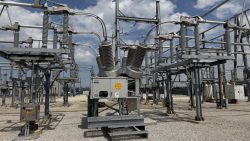
ComEd’s first 138-kilovolt clean-air vacuum circuit breaker, energized in May 2026 as part of the company’s evaluation of SF6-free transmission technologies.
“We’re being proactive,” Castillo said. “We’re piloting the technology and learning about it now so that if future regulations emerge, we’ll have the experience needed to continue delivering reliable service to our customers.”
While vacuum interruption technology has been used for decades at lower voltages, applying it at 138-kilovolt transmission-voltage levels represents one of the industry’s newer approaches for reducing greenhouse-gas emissions while maintaining system reliability. The breaker combines vacuum interrupters to extinguish electrical arcs with clean-air insulation to provide the performance required for transmission-voltage applications.
Before being placed into service, the breaker underwent extensive factory testing and industry qualification testing to verify its performance under transmission-system operating conditions.
Even after the new clean air breakers had been deployed, the analysis is ongoing. To support that work, ComEd’s parent company, Exelon, has partnered with the Electric Power Research Institute (EPRI), which helps utilities evaluate emerging technologies. ComEd engineers monitor equipment operating on the grid, while EPRI researchers put similar equipment through rigorous laboratory testing.
Together, those efforts help engineers understand how the technology performs over time and under a range of conditions. ComEd’s installation also provides valuable operating experience as part of an ongoing pilot program evaluating SF₆-free transmission technologies.
Building on the 138-kilovolt clean-air insulated vacuum circuit breaker, ComEd is also preparing to bring online a 345-kilovolt SF6-free breaker manufactured by Hitachi Energy. This option gives engineers another opportunity to evaluate a lower-emissions technology at an even higher voltage.
Across Exelon, other operating companies are building experience, too. Atlantic City Electric and Delmarva Power & Light, which serve southern New Jersey and the state of Delaware, respectively, were the first Exelon utilities to energize SF6-free transmission breakers, followed by PECO (serving Philadelphia and southeastern Pennsylvania) and ComEd, with BGE (Baltimore and central Maryland) targeting a future installation. Each deployment offers a chance to learn more about the technologies that could help shape the grid’s future.
“As new technologies mature, utilities will have additional options to reduce the environmental footprint of critical grid equipment while maintaining the reliability customers depend on,” Castillo said.
Most customers will never see a transmission breaker. But every cup of coffee brewed, phone charged and light switched on depends on the grid behind it. For ComEd engineers, testing cleaner breaker technologies is the necessary next step in keeping the grid reliable while working toward a cleaner energy future.
